Recently in Gita Category


Jagadguru Kripalu Parishat is presenting their Annual East Coast Intensive to be held at Vraj Ashram, Pennsylvania. This golden devotional opportunity will be led by Swami Nikhilanand and Sushree Diwakari Devi, senior disciples and pracharaks of Jagadguru Shree Kripalu ji Maharaj.

Application form: Click this link

Dates:
Friday, May 17, 2013 from 5:30 pm
through Sunday, May 19, 2013 at 2:00pm

Location:
The Jagadguru Kripalu Parishat East Coast Intensive will take place at Vraj Ashram, A beautiful temple and ashram on 300 acres in the foothills of the Appalachian mountains of Pennsylvania.
15 Manor Rd,
Schuylkill Haven,
PA 17972
[MAP]

Contribution:
- Includes program, accomodations & vegetarian meals
-$150 per adult (18 yrs. & older)
-$50 per child (6 - 17 yrs.) 5 & under free
-$50 per student (not working)

Please make checks payable to JKP Radha Madhav Dham.
Mail completed registration form and check to:
2012 East Coast Intensive
c/o Swami Nikhilanand
400 Barsana Road, Austin, TX 78737

Past Glimpses:

Radha Madhav Dham retreat led by devotees of Kripalu Maharaj
Group photo of Swami Nikhilanand and Diwakari Devi of Jagadguru Kripalu Parishat with East Coast Intensive participants 

Radha Madhav Dham retreat led by devotees of Kripalu Maharaj
Swami Nikhilanand leading parikrama with "Radhey Govind" chanting

Radha Madhav Dham retreat led by devotees of Kripalu Maharaj
Beautiful singing of bhajans by Jagadguru Kripalu Maharaj led by Sushree Diwakari Devi

Radha Madhav Dham retreat led by devotees of Kripalu Maharaj
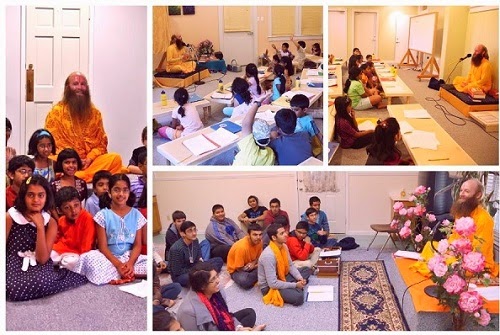
A few of the East Coast Intensive kids

Radha Madhav Dham retreat led by devotees of Kripalu Maharaj
Kids class led by Swami Nikhilanand, disciple of Kripalu Ji Maharaj

Radha Madhav Dham retreat led by devotees of Kripalu Maharaj
Ecstatic 'Radhey Radhey' kirtan by devotees of Kripalu Maharaj Ji

Radha Madhav Dham retreat led by devotees of Kripalu Maharaj
Devotional bonfire and singing of bhajans composed by Kripalu Maharaj Ji
Enhanced by Zemanta

Gita teachings of Jagadguru Kripalu Maharaj at Hindu Cultural Center of Connecticut
Jagadguru Shree Kripaluji Maharaj sanyasi pracharak, Swami Nikhilanand, to deliver FREE week-long series of Bhagwad Gita classes for parents and kids at Hindu Cultural Center of Connecticut  

RSVP via Swami Nikhilanand's official facebook page: Click here

Free Spring Break Program with Swami Nikhilanand, sanyasi disciple of Jagadguru Shree Kripaluji Maharaj and teacher at JKP Radha Madhav Dham

Dates:
Sun, April 14th 4:00-6:00pm
Mon- Fri, April 15-19 7:00-8:30pm
Sat, April 20 7:00-9:00pm

Venue:
Hindu Cultural Center of Connecticut
96 Chapel St.,
Standford,
Connecticut 06614
www.HinduCulturalCenter.org
Phone: (203) 375-9898

Topics:
Day 1: Four ways to surrender to God.
Day 2: What happens at the moment of death.
Day 3: Is the soul the same as God.
Day 4: The general & special Grace of God.
Day 5: The origin of the universe & the omnipotence of God.
Day 6: Arjun's Divine Vision.
Day 7: Devotion to personal of formless God.

Dinner will be served daily after prayer.


"The Essence of the Gita: The song of God"
7-day lecture and kirtan series by Swami Nikhilanand
Presented by Hindu Temple of Fresno

Dates:
January 20th - 26th, 2013.
Saturday & Sunday 10:30 - 12:30 pm
Monday - Friday 7 - 8:30 PM

Venue:
Hindu Temple of Fresno,
7699 E. Alluvial Avenue,
Clovis, CA. 93611
559-325-7233

Lecture topics:
January 20th: What is the Gita? How was it first told?
January 21st: The nature of the soul and of existence
January 22nd: The cycle of desire
January 23rd: The secret of God's appearance
January 24th: Devotional secrets of the Gita
January 25th: The origin of material bondage
January 26th: The meditation as taught in the Gita

Contact Monika Joshi - 559-325-2413 or Nilaxi Patel 559-905-2804


Shri Shirdi Sai Baba Mandir of Flushing, New York presents:


The Essence of the Gita: Chapters 7 - 12
Discourse & Kirtan by Swami Nikhilanand

December 2nd - 7th, 2012
Sun, Dec 2nd: 2pm - 4pm
Mon  - Fri, Dec 3rd - 7th: 7pm - 9pm

Location: Shri Shirdi Sai Baba Mandir
46-16 Robinson St.,
Flushing, New York 11355
718-321-9243
www.dwarakamaishirdi.org

Swami Nikhilanand is a sanyasi disciple and pracharak of Jagadguru Shree Kripaluji Maharaj and preacher of Jagadguru Kripalu Parishat. He studied Bhagavad Gita at its deepest levels under the guidance of Jagadguru Shree Kripaluji Maharaj, and he was one of the presiding leaders at the 6th Global Gita Conference in New York in 2008. If you live in New York, and have a curiosity to study chapters 7-12 of Bhagavad Gita, this event is for you (chapters 1 - 6 were covered in a previous session). Questions and answers sessions will also be provided throughout the week. The event is FREE.
Enhanced by Zemanta

Please visit www.SwamiNikhilanand.org for ALL Swami Nikhilanand's upcoming programs, blog posts and articles.

Swami Nikhilanand, disciple of Jagadguru Kripaluji Maharaj, to speak on karm yog of the Gita
Hindu Samaj Mandir of Mahwah, New Jersey presents a 3-part lecture:

"Karma Yoga of the Gita: How to Practically Apply it in Life"

Discourse & Kirtan by Swami Nikhilanand, pracharak of Jagadguru Shree Kripaluji Maharaj and sanyasi teacher at JKP Radha Madhav Dham.

Dates and Times 
July 20 - 22, 2012 
Fri, July 20, 7:00 - 8:30 PM 
Sat, July 21, 7:00 - 8:30 PM 
Sun, July 22, 3:00 - 5:00 PM 

Venue 
Hindu Samaj Temple 
247 West Ramapo Ave., 
Mahwah, New Jersey 07430 
201-529-1277 

Krishna and Arjuna in the Gita - Essay by Swami Nikhilanand, disciple of Jagadguru Shree Kripaluji Maharaj


Gita Chapter 2, Part 2 - by Swami Nikhilanand, disciple of Jagadguru Shree Kripaluji Maharaj and sanyasi teacher at JKP Radha Madhav Dham

In the beginning of the second chapter, Bhagwan Shree Krishn explains to Arjun from a sankhya point of view why he should not hesitate to fight the war. From this, we learned that our true identity is the soul, and the soul is eternal and indestructible.

Shree Krishn Explains the Law of Karm to Convince Arjun to Fight the War
Next He explains that, considering the law of karm (action and consequence), from that point of view too, Arjun should fight the war. As previously discussed (see Chapter 1, Part 8), it was clearly Arjun's duty to fight the war. So Shree Krishn tells him that if he does his duty, then he can't lose: if he fights the war and is killed, then he will be rewarded with entry to swarg; and if he fights the war and wins, then he will enjoy the sovereignty of the earth (chapter 2, verse 37). According to the law of karm, he will be rewarded whether he wins or loses the actual war, because he chose to do the right thing.

But if, choosing not to fight, he shirks his duty, he will incur sin which will bring suffering upon him in the next life. In addition, people will see him as a coward because they will assume that he left the battlefield out of fear. He would lose the respect of the other warriors. Thus, ruining his good name and bringing infamy upon himself, he would spoil his happiness in this life; and by incurring the sin of ignoring his duty, he would also spoil his happiness in the next life. Shree Krishn thus explained in simple, straightforward logic why Arjun should fight the war.

However, Arjun was not satisfied with worldly happiness. He had already told Shree Krishn that he did not desire the pleasures of kingship, nor did he desire to be victorious for his own personal glory (chapter 1, verse 32). This meant that the prospect of enjoying more happiness of this world was not an incentive for Arjun to fight the war.

The Futility of Worldly Happiness
In fact, Shree Krishn Himself had already explained the futility of worldly happiness earlier in chapter 2. He told Arjun that the world is full of pairs of opposites, like heat and cold, and pleasure and pain. This situation is such that within each pair of opposites the two keep alternating, which means no situation is ever stable or permanent. In other words, cold doesn't last forever - it eventually gives way to heat; and heat doesn't last forever - it eventually gives way to cold. Pleasure doesn't last forever - it eventually gives way to pain; and pain doesn't last forever - it eventually gives way once again to pleasure (chapter 2, verse 14). All situations are temporary, which means that worldly happiness is always fleeting. Thus, Shree Krishn advised Arjun to remain equanimous both in situations that bring pleasure and in those that cause pain.

He further exposed the nature of worldly happiness when He stated that what is fact cannot cease to exist, and if something does not exist, then it cannot become fact (chapter 2, verse 16). It means that truth is permanent, unchanging, and everlasting. If something is a fact, then it cannot cease being a fact. Accordingly, if the happiness of this world existed as a fact, then it could not stop being a fact. It would exist as a permanent state.

But it doesn't. It exists only as a fleeting experience in our mind, not as a substantial and real thing. We cannot enjoy anything in this world unceasingly. The longer we go on enjoying it, the more the enjoyment fades, until it finishes altogether. If the happiness was real, then where did it go? Why did it vanish? A fact cannot stop being a fact. If there was true happiness in tasty food, then we should be able to go on eating the same food continuously forever and the amount of enjoyment should always remain constant. If there was real happiness in beauty, then we should be able to go on staring at the same beautiful thing forever and never get bored of it; but it never happens that way, we get bored and want a change. Then where did the happiness go?

The truth is that there never was any happiness in those worldly things: not in the tasty food, not in the beauty, not in anything of this world. We experience happiness in the association of those things in proportion to our desire for them. The hungrier we are, the better food tastes, and the more pleasure we receive in eating it. The thirstier we are, the more we enjoy water. The longer we have been separated from the object of beauty, the greater our desire for it has grown, and the greater the pleasure we receive upon meeting with it.

But as we go on eating, our desire for food wanes, and the happiness we experience in eating decreases accordingly. As we go on drinking, our thirst is quenched, and our pleasure in drinking the water also disappears. The longer we go on looking at a beautiful thing, whether it is a person, or a painting, or any natural scene, the more accustomed to that thing we become, and the less desire we have to keep looking at it. Eventually, we become bored, and we want to look at something else. Eventually, we become full from eating or drinking, and we want to stop.

When we reach such a threshold, if we were forced to continue, then the very thing that initially gave us pleasure, would now start giving us displeasure. If we were forced to keep on staring at the same beautiful face or painting for hours on end, we would get fed up and not want to look at it anymore. If there was real happiness in these things, then how could we receive pain from the very same things?

If there was real happiness in any object or person of this world, then everyone would be able to get the same amount of enjoyment out of the same person or thing. Everyone would love chocolate and hate onions. But there is no consistency: some people love onions and hate chocolate. Everyone would feel the same happiness in seeing your son as you do. But they don't; you receive the happiness from your son, because you are attached to him. Your neighbor is not attached to him, so he is neutral towards him. He gets happiness from his son, not your son. Thus, we see that the so-called happiness is received based on the attachment of the mind, not based on the existence of happiness in that person or thing.

Our own experience of this world proves that it does not contain real happiness. We receive a temporary excitement when meeting with the object of our desire or attachment, but that fleeting feeling lives only in our mind, and is the creation of our mind. It has no real existence.

The next question is: if there is no real happiness in this world, then is there only pain? We will see what the philosophy of the Gita has to say about this in the next article.

Summary
Shree Krishn explains that, considering the law of karm, from that point of view too, Arjun should fight the war. As previously discussed, it was clearly Arjun's duty to fight the war. So Shree Krishn tells him that if he does his duty, then he can't lose. Because according to the law of karm, he will be rewarded, whether he wins or loses the actual war. However, Arjun was not satisfied with worldly happiness. He had already told Shree Krishn that he did not desire the pleasures of kingship, nor did he desire to be victorious for his own personal glory. This meant that the prospect of enjoying more happiness of this world was not an incentive for Arjun to fight the war.

Note: The entire Bhagavad Gita series by Swami Nikhilanand will continue, once or twice a week, for more than a year and will be an incredible study aid in learning the deepest aspects of Bhagavad Gita from one of the most profound and prolific speakers of Bhagavad Gita in the English speaking world today.

Enhanced by Zemanta

Bhagavad Gita speeches by Swami Nikhilanand, disciple of Jagadguru Kripaluji Maharaj

Gita Chapter 2, Part 1 (Eternity of the Soul, Whatever Exists Now Has Always Existed and Will Always Exist, Who Dies and Who Is Born?) - by Swami Nikhilanand, disciple of Jagadguru Shree Kripaluji Maharaj and sanyasi teacher at JKP Radha Madhav Dham

Eternity of the Soul
Having discussed the qualification to learn the Gita, we will now begin the topics of the second chapter. In the second chapter, Shree Krishn begins to answer Arjun. Although Arjun is a Divine personality, he is playing the part of a confused soul. Arjun is acting like an agyani - one who does not have correct spiritual knowledge - so that Krishn can reveal the correct knowledge for the benefit of the souls of the world. Arjun's fundamental confusion is the same confusion we all have: we believe we are the physical body, and we have forgotten that we are the Divine soul.

Shree Krishn begins by telling Arjun that he is speaking like a learned pandit - because he gave Krishn a whole lecture on why he was not going to fight the war - and yet he is grieving for his relatives in the way an unlearned man would. He tells him that the learned do not grieve for the dead or for the living (chapter 2, verse 11). Why not? Because whatever exists today has always existed and will always continue to exist (chapter 2, verse 12).

Whatever Exists Now Has Always Existed and Will Always Exist
The Ved states that there are three things that exist eternally. There is no fourth existence, or tattva. The three eternal tattva are: brahm (God), jeev (souls) and maya (the material energy that produces the world). All three have no beginning and will never end. All three have existed forever and will continue to exist for all eternity, because an existing thing cannot cease to exist, and a non-existent thing cannot be brought into being (chapter 2, verse 16).

It means that even God does not create something out of nothing. Although we call God the creator, yet He has never created any souls, nor has He created maya. The souls have existed forever and are as old as God - eternal. Maya is also an eternally existing energy, because energy cannot be created or destroyed. So God did not create maya either. God merely activates maya when He wants the universe to be created, and he de-activates maya when He wants the universe to dissolve. But maya does not cease to exist when the universe is dissolved. Nor do souls cease to exist at that time. During the dissolution of the universe, both maya and the souls stay within God in a dormant form. When God re-activates the mayic energy, then the universe is created, and the souls are sent forth to be born. This cycle of creation (srishti) and dissolution (pralaya) of the universe is eternal - it never began. So souls have always existed, and have been taking birth after birth since eternity in this endless cycle of srishti and pralaya of the material universe.

Who Dies and Who Is Born?
So who actually dies or is born? If something has alays existed, then it cannot be born; and if something will always continue to exist, then it never dies. That means that all three - God, the souls and maya - were never born and can never die. The only thing that can be born is a physical form made out of mayic energy. That form is temporary: it was created, and it can be destroyed.

If you go to the beach and use the sand there to make a sand castle, then you created a form out of something that was already there. You created the castle, not the sand. When a wave washes away your sand castle, then the castle is destroyed, but not the sand. Similarly, mayic energy manifests in various forms in this universe - as planets, stars, galaxies, etc., as well as the bodies inhabited by the living souls. The mayic energy is eternal, but the physical forms created by it are temporary - they are born and they die, just like your sand castle.

Our physical body was born and will one day die, but not the soul. The physical body passes through the phases of birth, growth, maturation, decline and death (chapter 2, verse 13), but not the soul, because the soul is eternal and unchanging. The soul is indestructible (chapter 2, verse 23) and is not killed by the death of the physical body (chapter 2, verse 20). When the body dies, the soul moves on to another body, just like we cast off old, worn out clothes and take new ones (chapter 2, verse 22). Therefore, only the physical body can die, and that was a certainty at the time of its birth, because whatever is born must one day die (chapter 2, verse 27).

For Whom Should We Grieve?
Then for whom should we grieve? For the physical body whose existence was always known to be short-lived and whose death was guaranteed the moment it was born? Or for the soul which can never be killed and will go on to take another body? Neither is worth grieving for. So it is only the unwise, or those who do not realize their Divine identity as the soul, who grieve for the death of anyone's physical body.

In this way, Shree Krishn instructed Arjun on the philosophy of sankhya, which tells that our true identity is as eternal Divine souls - our identity is not the temporary physical body. One who knows and accepts this does not grieve for the death of anyone, because he knows it is not they who have died, but only their physical body. Thus, Shree Krishn advised Arjun to perform his duty by fighting the war, and to fear neither his own death nor the death of the relatives against whom he would fight, because he cannot kill their soul, and they cannot kill his. Therefore, he should simply do what is right and do not worry about who will kill and who will be killed in the war.

After this, Shree Krishn explained to Arjun about the law of karm and that from that point of view as well, he should fight the war. That will be the topic of the next article.

Summary
In the second chapter, Shree Krishn begins to answer Arjun. He explains the philosophy of sankhya to him, which tells that our true identity is as eternal Divine souls - our identity is not the temporary physical body. One who knows and accepts this does not grieve for the death of anyone, because he knows it is not they who have died, but only their physical body. Thus, Shree Krishn advised Arjun to perform his duty by fighting the war, and to fear neither his own death, nor the death of the relatives against whom he would fight, because he cannot kill their soul, and they cannot kill his. Therefore, he should simply do what is right and not worry about who will kills and who will be killed in the war.

Note: The entire Bhagavad Gita series by Swami Nikhilanand will continue, once or twice a week, for more than a year and will be an incredible study aid in learning the deepest aspects of Bhagavad Gita from one of the most profound and prolific speakers of Bhagavad Gita in the English speaking world today.

Enhanced by Zemanta

Jagadguru Kripaluji Maharaj's disciple speaks of Duty vs. Attachment from Bhagavad Gita

Gita Chapter 1, Part 8 (Duty Vs. Attachment) - by Swami Nikhilanand, disciple of Jagadguru Shree Kripaluji Maharaj and sanyasi teacher at JKP Radha Madhav Dham

Chapter 1 is mainly the poorv pakch or question part of the Gita. In it, Arjun makes his confusion known to Krishn, Who then takes the next 17 chapters to clear Arjun's doubts and answer all of his questions. In fact, Shree Krishn did not speak a word in the first chapter. He listened and allowed Arjun to express whatever was in his heart before He said anything. Krishn's discourse - the uttar pakch or answer part of the Gita - did not begin until the second chapter.

Arjun's Duty
In the first chapter, we see that Arjun is not sure what his duty - or dharm - is in this situation. His ability to reason is clouded by his attachment to those against whom he is going to fight. In fact, if he was not related to or attached to any of the warriors in the other army, his duty would have been very clear to him.

What was Arjun's duty? In our modern terms, it can be compared to that of a police officer. The police officer has the duty to enforce the laws of the society. That means that he is supposed to protect those who follow the law, and prevent others from breaking the law. If someone does break the law, he is supposed to capture him and bring him to justice so he cannot keep doing it. If the one breaking the law refuses to obey the police officer and continues to break the law, then the officer may use force to stop him. If the criminal threatens the officer's life or the life of another citizen, the police officer may be justified in using lethal force - although he will exhaust all other options first. The use of force by the police officer is the last option.

In just the same way, Arjun had a duty to uphold the laws of the society in which he lived. This was his physical dharm. Duryodhan was breaking those laws. In order to protect the laws and the citizens, Arjun had a duty to stop him. Arjun and the Pandavs were on the side of dharm, and Duryodhan and the Kauravs were on the side of adharm. Before coming to the point of war, Arjun had exhausted all other options to resolve the situation; but Duryodhan would not compromise and demanded a war. So Arjun had only two options remaining: fight the war or allow Duryodhan to continue his evil ways unchecked. If a police officer finds himself in such a situation, then it is obvious what his duty is: he must use force to bring the criminal to justice.

Duty vs. Attachment
When Arjun's duty is so clear cut, then why was he confused? Only because of his attachment. When he saw the people against whom he was going to fight, his heart melted, because many of them were part of his extended family or were his elders who had educated him as a boy. Because they were dear to him, he became confused about his duty.

Is it right to fight against his own family? Although this may seem like a confusing situation, from the point of view of dharm, it is still perfectly clear. Ask yourself: if a police officer sees someone from his own family breaking the law, is he supposed to take his relation to them into consideration, or is he supposed to enforce the law equally, regardless of his personal attachments? The answer is obvious: he is required to enforce the law against a family member or loved one in the same way he would against a stranger. In fact, if he gives a family member or loved one any special consideration, he may be punished by his superiors or viewed as an accomplice in the crime.

Arjun's situation highlights this conflict between duty and attachment, which is something every person faces on a daily basis. Every day we are met with situations where we have to weigh duty versus attachment. If your own son was breaking the law, would you call the police or would you try to cover it up? Duty says to call the police. Attachment says to cover it up. It is for this very reason that Dhritrashtra was unable to do his duty as king. His attachment to his evil sons was so great that it made him helpless. Even though he knew what Duryodhan was doing was evil, he was powerless to stop him because he was unwilling to see his son get punished. In the end, Dhritrashtra was as responsible for all of his son's evil deeds as he was.

This is one of the central themes of the Gita, and is very relevant in our daily life. In the next article we will begin Chapter 2 and see how Shree Krishn began to resolve Arjun's confusion.

Note: The entire Bhagavad Gita series by Swami Nikhilanand will continue, once or twice a week, for more than a year and will be an incredible study aid in learning the deepest aspects of Bhagavad Gita from one of the most profound and prolific speakers of Bhagavad Gita in the English speaking world today. 

Enhanced by Zemanta

Connect & Share

Join our e-list

Daily Teachings

Pages

Powered by Movable Type 4.32-en

About this Archive

This page is an archive of recent entries in the Gita category.

February is the previous category.

Hinduism is the next category.

Find recent content on the main index or look in the archives to find all content.