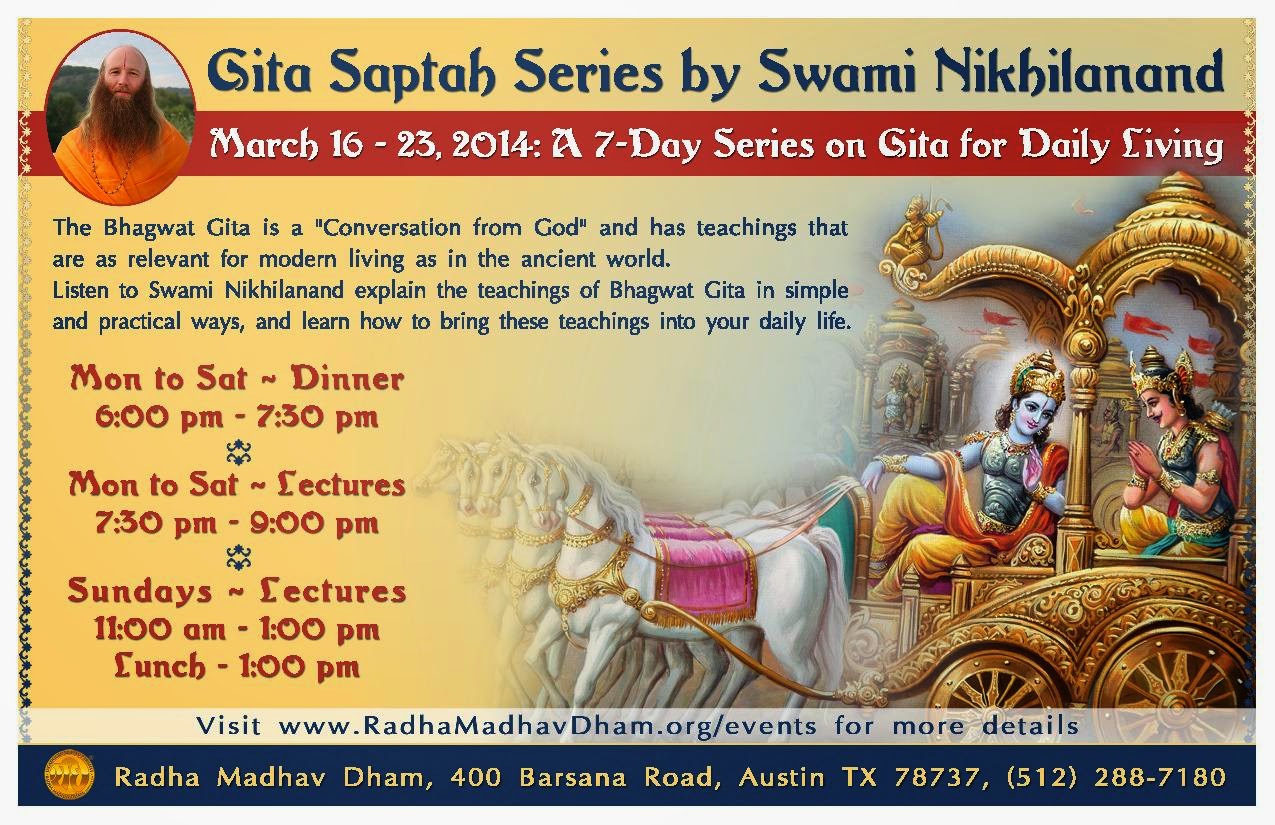
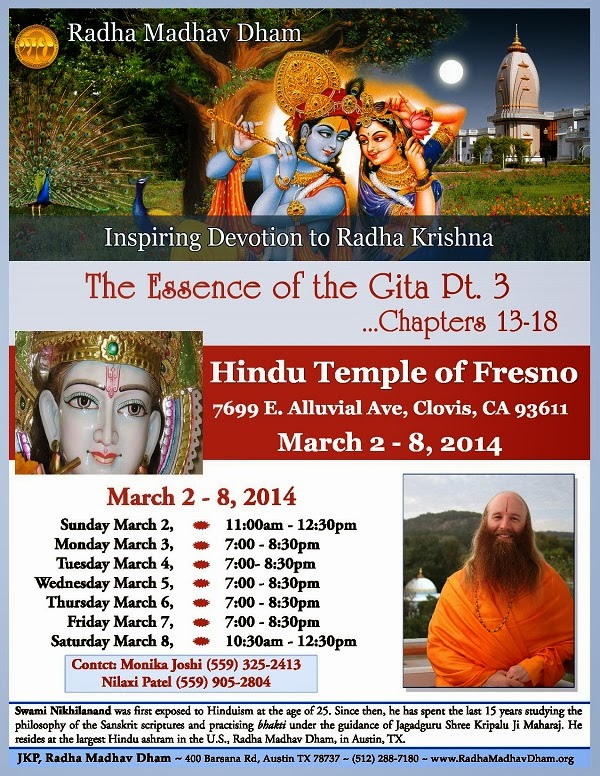
Come celebrate a traditional, braj-style Holi at Radha Madhav Dham, the US ashram of Jagadguru Shree Kripalu Ji Maharaj
Radha Madhav Dham, where the people are as diverse as the Holi colors; Let's Play
A conversation about Holi conjures up many different things for different people. Like all of our great Hindu festivals, Holi has numerous aspects; social, cultural, religious and spiritual. One thing that devotees and the community in America can enjoy in common though is the traditional Braj-style Holi at Radha Madhav Dham, the US ashram of Jagadguru Shree Kripaluji Maharaj. The thousands of people who come play Holi at this veritable Shangri-La of the Occident, and their reasons for coming, are as numerous and multifarious as the colors of Holi itself. That's what makes Holi at Radha Madhav Dham all the more unique, special and beautiful.
"Hindu festivals are so many that they would be impossible to count, but almost all of them commemorate some leela or Divine historical event. Holi is the day that Krishna protected His devotee Prahlad from being killed in a fire. The true meaning of any Hindu holiday/festival is to remember that the aim of life is to find God. We are supposed to remember this all the time, but the various festivals help us to re-focus our energy in this direction."
The Holi plays of Radha Krishna, which took place from time to time during their life, 5000 years ago, illustrate some of the highest platforms of Transcendental bliss, the meditation of which reveals deep experiences in the heart of a Radha Krishna devotee. Having the chance to actually play Holi in such a spiritually charged atmosphere as Radha Madhav Dham, keeping the feeling that you are participating in a real Holi scene with Radha Krishna, watching Krishna leelas being enacted by the devotees, feeling the Holi colors pour down on your body, mind and soul and listening to Holi songs revealed by Jagadguru Shree Kripalu Ji Maharaj from a live band are most conducive circumstances for feeling the sublime and all-enrapturing states of Radha Krishna love.
On the cultural and social level, nothing builds a lifetime bond with someone like throwing colored powered on them and having them throw colored powder on you. Nothing says "I love you!" like smearing moist powder in someone's face! And this is also a perfectly valid reason to participate in Holi. Building friendships, getting to know people you always wanted to but couldn't, leaving aside past prejudices and misunderstandings in the spirit of the celebration are all part and parcel of the overall Holi experience. Holi is one of those "holistic" experiences that you really have to take part in once to understand.
The most important thing about Holi is to make it your own. Make your own day which you'll always remember and think about. The Holi play this year will have many unique and enjoyable features including a live band singing Holi songs from Braj to liven up the environment. Attendees will also have the chance to participate in the traditional burning of demon Holika's effigy. This act helps to remind ourselves that evil always burns in the face of good. The deeper significance of Holi & Holika are included in the "Holi talk" by Swami Nikhilanand, which will be presented in English. A delicious Dinner Prasad cooked by the Austin community will be served after the temple program ends and before the outdoor Holi play begins.
Radha Krishna Holi Darshan at Radha Madhav Dham, the US ashram of Jagadguru Shree Kripaluji Maharaj
The highlight of the Holi celebration is the chance to receive the Holi darshan of Radha Krishna, who are the very heart and soul of Radha Madhav Dham. Meditating silently on the beautiful scene or joining the chanting is a really wonderful experience.
The preparation for Holi is extensive and you really feel it on the day. You see it in the faces of the devotees, as weeks' of feelings of gulal making, days of food management and all the necessary preparations required for such an event are just released on the day. Everyone lets loose and looses themselves in the magic of the day. "It's all for Radha Rani", they say.
This year is expected to be the grandest and most colorful festival ever celebrated at Radha Madhav Dham. A devotee told me that all the rooms have been booked up, weeks in advance. So all you have to do now is mark you calendars, get your old clothes out, pack your bags and head home to Radha Madhav Dham! Jai Shree Radhey!
Holi Schedule
3:00 p.m. Chant Braj-style Holi Pads and Chants revealed by Jagadguru Shree Kripalu Ji Maharaj
4:00 p.m. Listen to Swami Nikhilanand Ji's talk on Holi
5:00 p.m. Enjoy delicious Dinner Prasad
6:00 p.m. Watch Holika burn in the Holi Bonfire
6:30 p.m. Celebrate with Holi Colors to a Live Band
Beautiful bhajans and inspiring discourses with Swami Nikhilanand, based on the teachings of Jagadguru Shree Kripaluji Maharaj
Topics: Sat. March 2: What is more important, Religion or Science? Sun. March 3: Can science prove the existence of God? Mon. March 4: Why are there so many forms of God? Tue. March 5: Why are there so many paths to God? Wed. March 6: Are all religions the same? What makes Hinduism great? Thurs. March 7: Why are there so many sects and sampradayas within Hinduism? Fri. March 8: What does Hinduism say is the ultimate aim of human life?
Dates & Times:
Sat & Sun, March 2nd & 3rd: 6:00 pm - 7:30 pm
Mon - Fri, March 4th - 8th: 7:00 pm - 8:30 pm
Venue: Garg Residence
801 Madre Street
Pasadena California 91107
(626) 319 2064
This will be fascinating discourse that Swami Nikhilanand Ji, a pracharak of Jagadguru Shree Kripaluji Maharaj, has presented in Hindu Temples throughout New York, Texas, Virginia and all over the country. It could be a life-changing opportunity for you and your family and friends to experience beautiful teachings of Hinduism and enjoy uplifting chantings of the names of God.
Jagadguru Kripalu Parishat (JKP) was founded by Jagadguru Shree Kripaluji Maharaj, the fifth prime Jagadguru in the last 5000 years.Founded in 1990, the Radha Madha Dham Temple and ashram campus serves as the national center of Jagadguru Kripalu Parishat in the United States and is one of the largest Hindu temples in North America.
The exciting news for March 2013 is that Swami Nikhilanand, pracharak of Jagadguru Shree Kripaluji Maharaj, is coming to Long Beach, Canoga Park and Studio City, California in March 2013 for some beautiful lecture and kirtan series'.
1. The Soul's Quest for Happiness
Date: Sat., March 9th
Time: 4.00 - 5.30 PM
2. The Purpose of Meditation
Date: Sat., March 16th
Time: 4.00 - 5.30 PM
Venue: Trilogy Yoga
3141 E. Broadway
Long Beach California 90803
Contact: Cathy Stander (818) 825-8036
Both of these programs will include the use of kirtan (chanting) as an aid in meditation. Discourse by Swami Nikhilanand during his last trip to California:
1. March 15, 22 & 29: 3-part series at Follow Your Heart Yoga Studio, Canoga Park, CA
Where: 21835 Sherman Way,
Canoga Park,
CA 91303
Title: The Soul's Eternal Quest
When: Fri., March 15, 22 & 29
7:15 - 8:45 pm
Contact: Cathy Stander 815-825-8036
2. March 13, 20 & 27: Lionheart Institute, Studio City, CA
Where: 4370 Tujunga Avenue - Suite 150,
Studio City
Mangarh, March 7, 2012: Largest Ever Cataract Camp Held at Jagadguru Kripalu Chikitsalaya - by Sushree Janeshwari Devi of JKP India
Lines of elderly villagers, following one another closely with hands on each other's shoulders, saying, "Radhey Radhey" in unison, were about to become some of the 756 successful cataract surgery patients during a 3-day eye camp.
The semi-annual Cataract Surgery Camp was held on March 5-7, 2012, in Bhakti Dham, Mangarh, India. The camp was conducted during the Holi Sadhana program attended by 3,000 devotees from different parts of the world. Dozens of visiting devotees were happily volunteering alongside the hospital staff during their 12-hour-long shifts in the Jagadguru Kripalu Chikitsalya (eye hospital). They participated in such tasks as feeding patients, filing medical charts, folding linens and sterilizing medical equipment.
Jointly sponsored by Jagadguru Kripalu Parishat, Bhakti Dham, Mangarh and Tilganga Eye Center, Kathmandu, Nepal, this free camp was the largest held in the three years since the camps began. During the camp, all patients received free cataract surgeries, prescription medications, follow-up care and dark glasses to wear during their recovery.
Chief surgeon, Dr. Govinda Paudyal, who traveled from Kathmandu with a team of six medical professionals, performed a record 247 surgeries in one day during the camp. "I would like to do this camp four times a year," he said. "We have never advertised this camp because the news travels by word-of-mouth. If we did, we would not be able to handle the number of patients who would show up for free surgeries," he added.
"There was another miracle story during this camp," said K. S. Rathod, a full-time volunteer at the hospital. "At the last camp, a 13-year-old girl's vision was restored after being told by doctors elsewhere that she would never see again. And today, a 10-year-old girl, who was also told by her doctors that her vision could not be corrected, was successfully operated on," he continued.
The cataract camps are one of the many charitable activities conducted by Jagadguru Kripalu Parishat. On March 13th, 2,200 widows of Vrindaban were fed at Prem Mandir in Vrindaban, and parcels of essential items for daily living, such as cooking vessels, clothing and bedding, were given free to everyone.
Gita Chapter 1, Part 6 - by Swami Nikhilanand, disciple of Jagadguru Shree Kripaluji Maharaj and sanyasi teacher at JKP Radha Madhav Dham
So far we have learned that the qualification for studying the Gita is to have faith in Shree Krishn, and to be surrendered to a God realized Saint. Only through the Saint's explanation can we understand the true meaning of the Gita.
The Danger of Learning Gita on One's Own
Learning from a true Saint also saves us from one dangerous pitfall: the pride of knowingness. If someone studies the Gita on his own, he is bound to develop a pride in his knowledge. It is human nature to want to be appreciated, so it is a common human fault to want to show our knowledge to others to gain their respect and admiration. However, the development of such vanity is the opposite of what happens when someone has truly understood the spiritual teachings of the Gita. (The previous article explained in detail that no matter how great a scholar a person is, they cannot read and understand the Gita philosophy correctly unless they are already God realized.)
Our pride of "knowing" actually takes us farther from God, instead of closer. The more humble we are, the closer we come to God. The more proud we are, the farther we are from God. When we are humble, we feel that we belong to God and we depend on him totally. This is surrender, and this type of surrender is the essence of the Gita. When we have pride in anything, then due to the pride, we feel that we are great, which means that we are not depending on God. In other words, the more pride we feel, the less surrendered we are. That means that someone who studies the Gita on his own and develops a pride of his learning is now farther from God than before he had studied the Gita. Ironically, even though he studied the Gita, which teaches surrender, he ended up being less surrendered by the end of his study.
It means that, to the extent someone has imbibed the knowledge of Gita, they will become equally humble. More knowledge means more humbleness. More pride means the presence of ignorance. So it means that a learned scholar who studies the Gita on his own and ends up with more pride, has increased his ignorance, not his knowledge.
The only way to avoid this is to learn the Gita or any Hindu scripture from a God realized Saint. The Saint, while imparting the knowledge, will also ensure the humbleness of his students and will not give knowledge to an unqualified person.
It is also important to keep in mind that we don't get anything simply by hearing, reciting or memorizing the Gita. The teachings of the Gita have to be understood and practiced every day in one's life. Only then will the knowledge of the Gita take root in our heart and only then will we realize the benefit of Krishn's teachings. In other words, the theory must be put into practice. For this too we need the guidance of the Saint. It is only by practicing the teachings of the Gita under the guidance of a Saint that we develop true humbleness and surrender to Krishn.
The Qualification to Know Gita: Be Like Arjun
Also please consider that if we were truly qualified to hear Krishn's teachings, then we would immediately get God realized by listening to them, in the same way that Arjun did. So if we do not get God realized when we study the Gita, it means we have not understood it yet. Anyone can study the Gita, whether they are a Sanskrit scholar or an illiterate person. However, the true Gita gyani is the one who, having learned the philosophy of the Gita, becomes humble, surrenders to Shree Krishn and becomes God realized.
Having understood the qualification for studying the Gita, we are now ready to start learning the main topics of the first chapter of the Gita, starting with the very first verse. But, please keep in mind that whatever I am sharing with you in this series is not my own interpretation of the Gita. I have not learned the Gita on my own. I am simply doing my best to explain in English what Jagadguru Shree Kripaluji Maharaj has already taught the world through his speeches and books in Hindi.
Summary:
Trying to study any Hindu scripture, including the Gita, on one's own leads to a dangerous pitfall: the development of the pride of knowingness. However, the presence of such pride is a sure sign of ignorance. In order to learn the philosophy of the Gita without developing our vanity, it must be learned from a true Saint.
Note: The entire Bhagavad Gita series by Swami Nikhilanand will continue, once or twice a week, for more than a year and will be an incredible study aid in learning the deepest aspects of Bhagavad Gita from one of the most profound and prolific speakers of Bhagavad Gita in the English speaking world today.
Gita - Chapter 1, Part 5
- by Swami Nikhilanand, disciple of Jagadguru Shree Kripaluji Maharaj and sanyasi teacher at JKP Radha Madhav Dham The Second Qualification for Learning the Gita
In my previous entry, I explained that only a person who has faith in Shree Krishn is qualified to study the Gita. There is one more important qualification. In verse 34 of chapter 4, it says that the knowledge of the Gita cannot be acquired without first surrendering to a God realized Saint. Only with his help and guidance could the true meaning of the Gita be understood. This verse says that we must fully surrender (pranipat) to such a Saint who is both learned in the scriptures (gyaninah) and who has attained God (tattva darshinah). We should humbly and sincerely ask him questions (pariprashn) in order to clear our doubts and clarify the teachings of the Gita. We should also serve him (sevaya). Then he will impart the knowledge of the Gita to us (updekchyanti te gyanam).
Was Arjun surrendered to a Guru? Yes, in fact, he accepted Shree Krishn as his Guru when he said, 'shishyasteham shadhi mam tvaam prapannam' (chapter 2, verse 7). He said, "Krishn, please instruct me. I am your surrendered disciple." However, it is Krishn's rule that no one can surrender directly to Him (God). The procedure is that we must come to God through a Guru. He even sent the greatest gyani of that time, Uddhao, to the Gopis of Braj to be Graced with Divine love. In other words, He didn't Grace Uddhao directly, He sent him to the Gopis to make them his Guru. Then the Gopis Graced him with Krishn's Divine love.
That being so, why did Krishn allow Arjun to surrender directly to Him? In this case, since Krishn was physically present, Arjun had the choice: instead of saying, "Krishn, You are God. Please instruct me." He said, "Krishn, You are my Guru. Please instruct me." So, Krishn had to instruct him as a Guru instructs his surrendered disciple. If Arjun had said, "Krishn, You are God. Please instruct me." Then Shree Krishn would have said, "Go to a Guru. I cannot help you directly, as I am God."
Can We Make Krishn Our Guru?
Does this mean that we can accept Shree Krishn as our Guru, and thus become qualified to study the Gita? No, that is not possible for us, since He is not present before us in a physical form that we can see and relate to. We need a Guru who is physically present on the earth planet, whom we can serve and of whom we can ask questions.
What is the role of the Guru? The Guru is like a chemistry professor who instructs his students in the area of his expertise. The professor not only has a theoretical understanding of the subject, but has researched it, performed experiments, and had a practical experience of it. So, his knowledge is not only theoretical, it has been elevated to a practical, experiential level. Similarly, a true Guru must not only have a complete theoretical knowledge of the Hindu scriptures, but, more importantly, a practical experience of God.
Surrendering to the Guru to Receive Knowledge
If we have found such a Guru, then we could become qualified to study the philosophy of the Gita. The first thing we would have to do is to surrender to that Guru. Surrender? What does surrender have to do with acquiring knowledge? It has everything to do with it. In fact, the chemistry students must also surrender to their professor in order to learn. They surrender their intellect, or they join their intellect to the intellect of their professor. They allow him to guide them through the journey of acquiring this advanced knowledge of chemistry. They even take some things on faith, because at their elementary level of understanding, they have not experienced any of the things he is teaching them. So, they learn the theory and take it on faith, until such a time when they can experience it for themselves. That experience is the proof of the theory, which they had accepted on faith. It is important to note that without faith in the teacher, the theory cannot be learned, and without learning the theory, experience cannot be gained. Thus, faith is the gateway to gaining knowledge, and eventually proof or experience.
The same is true for acquiring spiritual knowledge and experience. We must have faith in (be surrendered to) the Guru. The true Saint can make us understand the philosophy of the Gita, but only if we humbly surrender our intellect to him. Initially, we have to accept what he is saying on faith; then, when we practice accordingly, we will receive the experience. So, in the spiritual field as well, faith and surrender are the gateway to knowledge and experience.
Please keep in mind that he can only impart that knowledge to us if we surrender to him. Otherwise, whether they are chemistry students, or students of the philosophy of the Gita, if they doubt every little thing their teacher tells them, they will never be able to learn the advanced material being taught in that course, nor will they ever gain the practical experience of that subject. They should question, but question humbly, in an effort to understand - not question in an effort to challenge the teacher or show one's own learning.
There is one more way that the Guru helps his students in their quest for knowledge. This will be the topic of the next part of this series.
Note: The entire Bhagavad Gita series by Swami Nikhilanand
will continue, once or twice a week, for more than a year and will be
an incredible study aid in learning the deepest aspects of Bhagavad Gita
from one of the most profound and prolific speakers of Bhagavad Gita in
the English speaking world today.Related articles
Latest article by Vyasar Ganesan. Vyasar was born in Derry, New Hampshire, and raised in Austin. His mother is from near Delhi, and his father comes from southern India. He currently is a senior at Allegheny College, working on a senior project in creative nonfiction. Vyasar is a blogger for Radha Madhav Dham, the main US ashram of Jagadguru Shree Kripaluji Maharaj.
It's sunny in Pittsburgh today. The sun is unseasonably bright, not just for March, but for spring even. Light is coming in through the windows, the screen door - even through the cracks in the blinds and the spaces between the frames. At this house, this where place I am, I'm surrounded by light in the daytime, and it feels amazing.
During the night before, there was nothing but darkness, deep and black. It seems that as warm and bright as it could get in the day, the nighttime was magnified in gloom just as much. I could hear the near-feral cats outside, yowling and howling at the moon, passing cars, whatever. There were dark shapes in my room, bits and pieces of shadows that flit past my pillow. The joy of the sun vanishes in the pale terror of the moon.
This is identical, in almost every way, to the yug we live in today. Maharajji never fails to remind us that if we want to become God-realized, the time for it is running out. We do not know when our next human life will be, our next chance at finding our beloved Radha and Krishn. Kaliyug is the last and shortest in the cycle of the yugas, where we have the least amount of time to follow the guidance of our Guru. To make matters worse, kaliyug is the age of materialism, the time when it feels better to perform selfish or evil actions than it does to promote virtuous ones. If you've ever had the feeling that things used to be better when you were younger, or that people are worse now, or the state of affairs is deteriorating, you don't know how right you are, nor how far we have to fall.
Whatever happiness we get out of this world is fleeting. That's the lesson of the shining days and fearsome nights. But when we seek happiness in the Divine, in the power of God, we find that the feeling stays. We are blessed with the teachings and love of our Guru, the only one who is capable of leading us to the light of truth. The lesson we need to learn, the understanding we need to get, is not to pray for the day to be eternal, but for the faith that one day, when we find God, the day will be eternal.
Painting of Krishna, Arjuna. (Bhagavad Gita) (Photo credit: Wikipedia)
Gita - Chapter 1, Part 4 - by Swami Nikhilanand, disciple of Jagadguru Shree Kripaluji Maharaj and sanyasi teacher at JKP Radha Madhav Dham
So far I have explained in gist what the Gita is, what its origins are, and how we can have confidence that the Gita available today is an authentic account of the conversation that took place between Krishn and Arjun on the battlefield of Kurukchetra more than 5,000 years ago. Now I'll discuss the qualification for receiving the knowledge of the Gita.
The Right Way to Acquire Knowledge
Every knowledge has restrictions with regard to who can learn it. This is as true in material matters as it is in spiritual matters. Before beginning a Masters degree, one must have completed his undergraduate degree in that subject. Otherwise, he will not grasp the knowledge being given by his professor at the post-graduate level, and instead of progressing in his understanding, he will only become more confused. The spiritual knowledge given by the various Hindu scriptures is also of different levels, from beginner to advanced. This is why every Hindu scripture has a specific qualification that must be met before someone can study it or learn it correctly. If an unqualified person attempts to study any scripture, then, instead of gaining clarity about the philosophy of Sanatan Dharm, he will only become more confused.
Further, some types of knowledge can even be harmful to an unqualified person. For example, if someone learns that aspirin cures headaches, but doesn't know what the proper dosage is, he may swallow the whole bottle, assuming that if one is good, then more must be better. In other words, knowledge partially or incorrectly understood can be more harmful than no knowledge at all. In spiritual matters as well, if the teaching of a particular scripture isn't precisely and fully understood, it may be misinterpreted, and instead of helping a person on his spiritual path, his wrong understanding becomes an obstacle. This is why we must pay heed to the statements of each scripture telling what the qualifications are to study it.
The Qualification to Study the Gita
The qualification to learn the Gita is as follows: in chapter 18, verse 67, the Gita says that one who does not have faith in Shree Krishn should not hear the Gita. When translating this shlok, Jagadguru Shankaracharya said this means if a person does not have faith that Krishn is bhagwan, he is not qualified to listen to or read the Gita.
Did Arjun have faith that Shree Krishn is God? Certainly he did. Otherwise, when given the choice, why would he have chosen a weaponless Shree Krishn over His entire army? When both Arjun and Duryodhan went to Dwarika to ask Shree Krishn's help in the war, He gave them a choice: one could have Him on their side, but with the condition that He would not lift a weapon for the whole war; and one could have His entire army, consisting of (number of divisions, etc.). Arjun was given the first choice, and he chose Krishn over His army. Who in his right mind would make such a decision, unless he believed that Krishn was God?
Even God Cannot Convince an Unfaithful Person
On the other hand, look at Duryodhan's reaction: he was relieved that Arjun had chosen Krishn and thought that he was extremely foolish to have not chosen His army. In other words, he had no faith in Shree Krishn. Later, when Krishn went to Duryodhan as a messenger of peace in order to avert the war, Duryodhan would not heed His advice. He insulted Krishn and tried to have Him imprisoned. Krishn even revealed His Divine almighty form before Duryodhan in an effort to influence him, but even then he did not accept Krishn's Divinity. It is amazing to think that even if God Himself comes to a person, if that person is not humble and faithful, then even God cannot help him. Then is it any wonder that Krishn chose to reveal the Gita to Arjun, instead of Duryodhan? A person must be humble to be open to the spiritual teachings, and faithful to accept them.
Thus, we see that an unfaithful person, no matter how learned or intelligent he is, is unqualified to receive the teachings of the Gita. There is one more important qualification to learn the Gita, which I will cover in the next part of this series.
Summary:
Every knowledge has restrictions with regard to who can learn it. If an unqualified person attempts to study any scripture, then, instead of gaining clarity about the philosophy of Sanatan Dharm, he will only become more confused. Further, some types of knowledge can even be harmful to an unqualified person. So, what is the qualification to study the Gita, and what can we learn from the examples of Arjun and Duryodhan? Find out by reading the article.
Note: The entire Bhagavad Gita series by Swami Nikhilanand will continue, once or twice a week, for more than a year and will be an incredible study aid in learning the deepest aspects of Bhagavad Gita from one of the most profound and prolific speakers of Bhagavad Gita in the English speaking world today.Related articles
Step 2. Attending a free talk and a 7-day Radha Madhav Dham Bhagavad Gita Family Camp at convenient venues in New York, Austin, Dallas, Houston or Washington D.C. where Swami Nikhilanand is regularly invited as a guest speaker.
Step 3. Visiting www.JKP.org and www.RadhaMadhavDham.org to learn more about the teachings and national and international activities of Jagadguru Shree Kripaluji Maharaj and JKP Radha Madhav Dham or to purchase books and DVDs by Jagadguru Shree Kripaluji Maharaj and JKP Radha Madhav Dham.